

GST Registration
Online GST Registration
Register for GST online with dedicated experts from IndiaFilings. We take care of documentation, application filing, query resolution and approvals – so you can focus on business.
GST Registration Online in India – Eligibility, Documents, Fees & Process
GST registration is an essential requirement for businesses in India to comply with the Goods and Services Tax (GST) regulations. Any business with an annual turnover exceeding ₹40 lakh (or ₹20 lakh in certain special category states) must obtain GST registration. This process involves securing a unique 15-digit GSTIN (Goods and Services Tax Identification Number) issued by the tax authorities. With GST registration, businesses can legally collect and remit GST, claim input tax credits, and operate in full compliance with GST laws.
IndiaFilings offers professional assistance and complete end-to-end support for seamless online GST registration. Our experts simplify the entire process — from filing new applications and tracking application status to resolving any queries raised by GST authorities. Get your GST registration completed online through IndiaFilings in as little as 2 business days and ensure full tax compliance effortlessly.
Who Should Apply for Goods and Services Tax (GST) registration?
Goods and Services Tax (GST) registration is mandatory for specific businesses and individuals to ensure compliance with India’s Goods and Services Tax laws. Below are the categories required to register under GST:
- Service Providers: Individuals or businesses providing services with an annual turnover exceeding ₹20 lakh (₹10 lakh in special category states) must register for GST. This includes freelancers, consultants, and agencies.
- Previously Registered Entities: Businesses previously registered under VAT, Service Tax, Excise, or any other indirect tax laws must migrate to GST.
- E-commerce Sellers and Operators: Anyone selling goods or services online through platforms like Amazon, Flipkart, or their own website must register for GST, regardless of turnover.
- Inter-State Suppliers: Businesses engaged in supplying goods or services across state boundaries are required to register for GST, irrespective of turnover.
- Casual Taxable Persons: Individuals or entities occasionally supplying goods or services in a taxable area without a permanent place of business must register.
- Agents of Suppliers: Agents or representatives who supply goods or services on behalf of others must obtain GST registration.
- Input Service Distributors (ISD): Businesses distributing GST input tax credit to other branches or units need to register as ISDs.
- Non-Resident Taxable Persons: Foreign individuals or entities supplying goods or services in India must register as non-resident taxable persons.
- Reverse Charge Mechanism (RCM) Entities: Businesses liable to pay tax under RCM—where the recipient pays the GST instead of the supplier—must register.
- Specialized Categories: Entities such as TDS deductors, TCS collectors, and OIDAR (Online Information and Database Access Retrieval) service providers are also required to register under GST.
IndiaFilings offers expert support to help you determine your eligibility for GST and complete your Online GST registration quickly and accurately.
GST Registration Limits
Under GST law, Goods and Services Tax registration is mandatory for businesses with an annual turnover exceeding ₹40 lakhs (for sale of goods in normal category states) and ₹20 lakhs (for sale of goods in special category states). If your turnover crosses these limits, you must register as a regular taxable entity under GST.
The GST Council sets these thresholds and makes recommendations on GST rates, exemptions, and related tax policies. Below is a detailed breakdown of the current and earlier threshold limits:
Current GST Registration Limits (Effective from 1 April 2019)
| Type of Supply | Threshold Limit | Applicable States |
| Sale of Goods | ₹40 lakh | Normal Category States |
| Sale of Goods | ₹20 lakh | Special Category States |
| Providing Services | ₹20 lakh | Normal Category States |
| Providing Services | ₹10 lakh | Special Category States |
Summary:
- For goods → ₹40 lakh (normal states) / ₹20 lakh (special states)
- For services → ₹20 lakh (normal states) / ₹10 lakh (special states)
Old GST Registration Limits (Before 1 April 2019)
| Type of Supply | Threshold Limit | Applicable States |
| Sale of Goods / Providing Services | ₹20 lakh | Normal Category States |
| Sale of Goods / Providing Services | ₹10 lakh | Special Category States |
The threshold limit for GST registration is calculated on aggregate turnover, which includes:
- All taxable supplies
- Exempt supplies
- Exports of goods or services
- Inter-state supplies
- Businesses exceeding these limits must register for GST; otherwise, registration is optional.
- Timely GST registration ensures compliance with GST laws, allows claiming input tax credit, and avoids penalties.
Special Category States: The GST registration limit is lower in special category states:
- Assam, Arunachal Pradesh, Manipur, Jammu & Kashmir, Meghalaya, Nagaland, Mizoram, Sikkim, Tripura, Uttarakhand
At IndiaFilings, we help businesses quickly determine their GST eligibility, prepare accurate documentation, and complete the registration process online in just a few days, ensuring full compliance with GST regulations.
Click here to know in detail: GST Registration Threshold
Mandatory GST Registration for Specific Businesses
While Online GST registration is generally based on turnover thresholds, it is mandatory for certain businesses and individuals, regardless of their turnover. These include:
- Interstate Suppliers: Individuals supplying goods or services across state borders. (Threshold: ₹20 lakh for most states, ₹10 lakh for special category states; applicable for taxable services, handicraft goods, and handmade goods)
- Casual Taxable Persons: Individuals or businesses making occasional taxable supplies without a fixed place of business
- Reverse Charge Liability: Persons required to pay tax under the reverse charge mechanism for inward supplies
- Non-Resident Taxable Persons: Foreign individuals or entities supplying goods or services in India
- E-commerce Operators: All e-commerce platforms and individuals supplying goods or services through such platforms
- TDS Deductors: Individuals required to deduct tax under Section 51
- Input Service Distributors (ISD): Entities distributing GST input tax credit to other entities
Voluntary GST Registration for Businesses
Even if a business generates a turnover of less than ₹20 lakh, it can apply for Goods and Services Tax (GST) registration voluntarily. While not mandatory, voluntary registration provides several significant advantages for small and growing businesses:
Benefits of Voluntary GST Registration
- Claim Input Tax Credit (ITC): Reduce tax liability by claiming credit on GST paid for purchases.
- Inter-State Sales: Conduct unrestricted interstate transactions without worrying about turnover thresholds.
- E-Commerce Eligibility: Become eligible to list products on online marketplaces like Amazon, Flipkart, and others.
- Competitive Advantage: Gain credibility and trust with customers and suppliers compared to non-registered businesses.
- Business Growth: Open doors to expansion opportunities and potentially higher profitability.
Voluntary GST registration is a smart choice for businesses looking to scale operations, improve compliance, and enjoy the benefits of the GST framework.
Latest Update: Simplified GST Registration in 3 Days
In line with the government’s efforts to streamline compliance for small businesses, the Simplified GST Registration Scheme under Rule 14A of the CGST Rules, 2017 has been introduced. Effective from 1st November 2025, this fast-track, Aadhaar-authenticated registration process allows eligible businesses to obtain GST registration within just 3 working days. This scheme is specifically designed for small taxpayers with a monthly output tax liability not exceeding ₹2.5 lakh on B2B supplies, significantly reducing the time and effort required for registration. This simplified process is available for service providers and B2B suppliers who meet the eligibility criteria, ensuring that businesses can quickly enter the GST ecosystem and focus on growth. At IndiaFilings, we are fully equipped to assist you in navigating this new process, providing a seamless and efficient GST registration experience. Get your business GST-registered in just 3 days!
GST Registration Documents Required
Below, we have given the Online GST registration documents to use as a checklist. These are all important to proceed with the GST number apply online,
| Sole proprietor / Individual | PAN card of the ownerAadhar card of the ownerPhotograph of the owner (in JPEG format, maximum size 100 KB)Bank account details*Address proof** |
| LLP and Partnership Firms | PAN card of all partners (including managing partner and authorized signatory)Copy of partnership deedPhotograph of all partners and authorised signatories (in JPEG format, maximum size 100 KB)Address proof of partners (Passport, driving license, Voters identity card, Aadhar card etc.)Aadhar card of authorised signatoryProof of appointment of authorized signatoryIn the case of LLP, registration certificate / Board resolution of LLPBank account details*Address proof of principal place of business |
| HUF | PAN card of HUFPAN card and Aadhar card of KartaPhotograph of the owner (in JPEG format, maximum size 100 KB)Bank account detailsAddress proof of principal place of business |
| Company (Public and Private) (Indian and foreign) | PAN card of the CompanyCertificate of incorporation given by Ministry of Corporate AffairsMemorandum of Association / Articles of AssociationPAN card and Aadhar card of authorized signatory. The authorised signatory must be an Indian, even in case of foreign companies/branch registrationPAN card and address proof of all directors of the CompanyPhotograph of all directors and authorised signatory (in JPEG format, maximum size 100 KB)Board resolution appointing authorised signatory / Any other proof of appointment of authorised signatory (in JPEG format / PDF format, maximum size 100 KB)Bank account detailsAddress proof of principal place of business |
Click here to get the Complete List of Documents Required for GST Registration
Step-by-Step GST Registration Process
Completing your Online GST registration Process is simple when you follow these steps with IndiaFilings:
1. Connect with Our GST Experts
Book a consultation with our team to resolve all your GST-related queries and get personalized guidance for your business.
2. Provide Business Information
Share the necessary details and documents to initiate your GST registration. Key information includes:
- Business name and PAN
- Principal place of business and additional locations
- Mobile number and email address
- SEZ unit details (if applicable)
- State of operation
Providing accurate and complete information ensures a smooth GST registration process and avoids delays.
3. Filing Your GST Application
Our experts will GST apply online on your behalf by submitting the registration application on the official GST portal. You will receive an OTP for verification to proceed further.
4. Receive Your GSTIN
Once verified, you will receive an Application Reference Number (ARN) to track your application status. After approval, your GST registration certificate (GSTIN) will be available on the official GST portal.
Important Notes:
- Submit all required documents within the specified timelines as per government guidelines.
- There are no GST registration fees, but security deposits may apply for casual and non-resident taxable persons.
- Your GST certificate is issued directly by the Central Government.
With IndiaFilings, the entire GST registration process is quick, hassle-free, and fully guided from start to finish.
GST Registration Fees
Register for GST in India is mostly free, but certain categories of applicants may need to pay a security deposit. Here’s a breakdown:
| Type of Applicant | Registration Fee on Government Portal | Additional Requirement |
| Most Regular Businesses | ₹0 (No Fees) | None |
| Casual Taxable Persons | ₹0 (Registration) + ₹500–₹10,000 (Security Deposit) | Deposit varies based on business type and state regulations |
| Non-Resident Taxable Persons | ₹0 (Registration) + ₹500–₹10,000 (Security Deposit) | Mandatory deposit for temporary or foreign business setups |
With IndiaFilings, you can complete your Online GST registration online quickly, without worrying about hidden fees or compliance issues.
Types of GST Registration in India
The Indian Goods and Services Tax (GST) system is structured to streamline taxation and cover all types of transactions. GST is divided into four main types, each applicable to different scenarios:
1. Central Goods and Services Tax (CGST)
- Applied to the supply of goods and services within a single state.
- Revenue collected under CGST goes to the central government.
2. State Goods and Services Tax (SGST)
- Applicable to sales of goods or services within a state.
- Revenue from SGST is collected by the state government.
3. Integrated Goods and Services Tax (IGST)
- Imposed on interstate transactions, i.e., goods or services moving across state borders.
- Collected by the central government and later shared between the central and state governments.
4. Union Territory Goods and Services Tax (UTGST)
- Levied on the supply of goods and services within Union Territories such as Andaman and Nicobar Islands, Daman and Diu, Dadra and Nagar Haveli, Lakshadweep, and Chandigarh.
- Charged along with CGST; the revenue goes to the Union Territory administration.
Advantages for Businesses with GST Registration
Registering for GST is a crucial step for businesses in India to comply with the unified tax system. Beyond legal compliance, GST registration provides several significant advantages:
1. Legal Recognition
GST registration gives a business official legal status as a supplier of goods or services. This recognition helps in building credibility with clients, suppliers, and financial institutions.
2. Input Tax Credit (ITC)
Registered businesses can claim Input Tax Credit, which allows them to deduct the GST paid on purchases from the GST collected on sales. This reduces the overall tax liability and improves cash flow.
3. Simplified Compliance Process
GST has streamlined tax compliance by consolidating multiple indirect taxes into a single system. Businesses can manage tax payments, file returns, and track obligations efficiently through a single online portal.
4. Composition Scheme for Small Businesses
Small businesses can opt for the GST Composition Scheme, paying tax at a lower fixed rate. This scheme reduces both the tax burden and compliance requirements, making financial management simpler.
5. Higher Threshold for Mandatory Registration
With a higher turnover threshold, only businesses with annual turnover above ₹40 lakh (for goods) are required to register in most states. This exempts smaller businesses, easing their operational processes.
6. Eliminates the Cascading Effect of Taxes
GST allows businesses to claim input tax credit across the supply chain, effectively eliminating the cascading effect of taxes. This reduces the overall tax burden on businesses and end consumers.
IndiaFilings can help businesses register for GST quickly and hassle-free, ensuring you enjoy all the benefits while remaining fully compliant with GST laws.
GSTIN and Its Significance
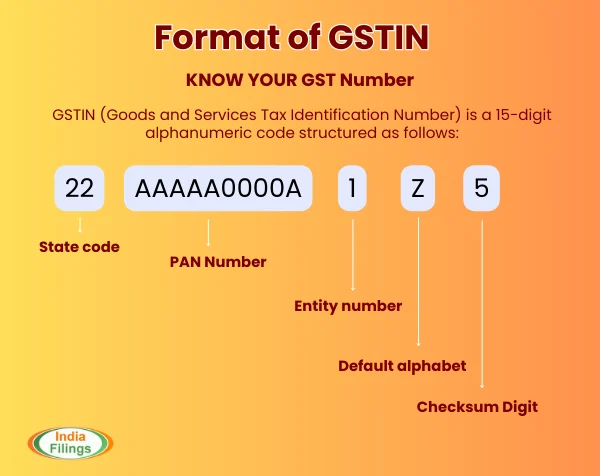
A GSTIN (Goods and Services Tax Identification Number) is a unique 15-digit code assigned to every taxpayer registered under the GST system in India. It serves as an identification for dealers, suppliers, and other business entities and is essential for legal compliance under GST.
Importance of GST number
- Transparency: Helps the government track all GST-related transactions and prevent tax evasion.
- Access to Benefits: Enables businesses to claim Input Tax Credit (ITC) on purchases and avail various government assistance programs.
- Credibility: Enhances trust with suppliers, customers, and financial institutions.
- Business Operations: Essential for availing loans, claiming refunds, verifying tax details, making corrections, and conducting interstate or intrastate business.
You will receive your GST number (GSTIN) after successfully submitting your application through the GST online portal. It acts as your official identity under the GST regime and is a key tool for smooth business operations and compliance.
GST Certificate
The GST Certificate stands as an authoritative document provided by the Indian government to entities that are registered under the Goods and Services Tax (GST) framework. This certificate confirms a business’s legitimate Registration under GST and prominently displays key details such as the GST identification number, the business name, and the official address. Ensure to initiate the GST registration online apply process and obtain it to be compliant.
Possessing an authentic GST Certificate online is pivotal for enterprises because:
- Tax Collection Authority: It empowers businesses to impose and gather GST from their clientele.
- Tax Credit Claims: With this certificate, businesses can rightfully claim credits on the GST they’ve disbursed on their procurements and operational costs.
- Furthermore, beyond its tax-related functions, the GST Certificate holds significance in several other domains:
- Loan Applications: When seeking financial aid or loans, businesses might be asked to present their GST certificates to validate their authenticity.
- Government Tenders: To be eligible and participate in official government tenders, the GST Certificate must often be produced as evidence of tax compliance.
- Market Reputation: The GST certificate online enhances a business’s stature in the market, reflecting its commitment to national tax regulations.
Penalties and Consequences for Non-Compliance with GST
Failing to register for GST can result in significant penalties. It is essential for businesses to stay compliant to avoid fines, interest, and legal action.
1. Penalties for Late Filing or Non-Payment
- Late GST Return Filing: Submitting GST returns beyond the deadline incurs a late filing penalty.
- Interest on Outstanding Tax: If GST liabilities are not paid on time, interest is charged on the outstanding amount.
- Short Payment of Tax: Taxpayers who underpay must pay a penalty of 10% of the tax due, with a minimum of ₹10,000.
- Maximum Penalty: The maximum penalty for non-compliance can reach 10% of the total tax amount due, along with interest on overdue taxes.
2. Consequences of Not Registering for GST
- Any taxable person who fails to register despite being required to do so faces a penalty of ₹10,000 or the tax evaded/short-paid, whichever is higher (Section 122, CGST Act).
- In severe cases, the penalty for non-registration can go up to ₹2 lakh.
- Non-registration may also lead to suspension or cancellation of GST registration, restricting your ability to legally collect GST and claim Input Tax Credit (ITC).
Common Mistakes to Avoid During GST Registration
1. Incomplete or Incorrect Documentation
One of the most frequent errors during GST registration is submitting inaccurate or incomplete documents. Maintaining organized records such as invoices, bills of supply, and purchase details is crucial for smooth registration and future compliance.
2. Errors in Invoice Details
Mistakes in invoices — such as incorrect GSTIN, wrong invoice numbers, or faulty tax calculations — can lead to discrepancies, compliance issues, and even penalties.
3. Mismatch Between GSTR-2A and GSTR-3B
Failing to reconcile purchase data reported in GSTR-2A with self-declared figures in GSTR-3B often results in inconsistencies and input tax credit mismatches.
4. Unverified Supplier GSTINs
Not validating your suppliers’ GSTINs on the official GST portal can cause serious compliance risks. Transactions with fake or invalid GSTINs can lead to denial of input tax credits.
5. Missing Return Filing Deadlines
Delays in filing GST returns attract penalties and interest. Staying updated on return due dates and ensuring timely submission is essential for compliance.
6. Misunderstanding the GST Composition Scheme
A lack of awareness about the eligibility criteria and limitations of the GST Composition Scheme can result in incorrect filings and penalties.
7. Ignoring GST Notices and Compliance Requirements
Disregarding GST notices or failing to respond promptly can escalate into legal complications and significant financial penalties. Always address notices immediately and maintain proactive compliance.
Categories That Require GST Registration in India
As per GST regulations in India, certain business sectors and service providers are mandatorily required to obtain GST registration, either based on turnover thresholds or specific notification under GST law. Below is a list of common categories and sectors that must register for GST:
Education and Learning
Educational institutions offering taxable services such as private coaching, online courses, or commercial training centers must register under GST if their turnover exceeds the threshold.
Health and Wellness
Though core healthcare services are exempt, health tech platforms, fitness centers, and alternative wellness services (like Ayurveda or naturopathy) may need GST registration if offering taxable services.
Electricity, Water & Local Utility Services
Private utility service providers (excluding government bodies) involved in supply or maintenance of electricity, water purification, and other civic services may require registration.
Money, Finance & Taxes
Chartered accountants, tax consultants, insurance agents, and financial advisors who charge for their professional services must register under GST.
Jobs and HR Services
Recruitment agencies, staffing firms, and freelancers offering HR and employment services are taxable and require GST registration.
Law, Justice & Grievance Redressal
Legal professionals and law firms (excluding those under reverse charge for senior advocates) may need to register if they offer taxable services beyond the threshold.
Travel & Tourism
Travel agencies, tour operators, hotel booking platforms, and transport aggregators must register under GST for offering taxable travel-related services.
Business & Self-Employment
Any business entity, trader, or self-employed professional whose annual turnover exceeds ₹20 lakh (₹10 lakh in NE states) is required to register for GST.
Births, Deaths, Marriages & Childcare
Entities offering paid services like event management, childcare centers, and private registry services must obtain GST registration.
Pensions and Benefits
Though government pensions are exempt, private pension funds or financial intermediaries offering pension-related services may be liable to register.
Transport & Infrastructure
Logistics companies, courier services, and private transport contractors need GST registration due to the taxable nature of their services.
Citizenship, Visas & Passports
Visa processing agencies and consultancy services related to immigration and citizenship services are taxable under GST and must be registered.
Agriculture, Rural & Environment
Agro-product sellers, farm equipment manufacturers, and environment consultancies may require GST registration based on turnover.
Science, IT & Communications
IT firms, web developers, SaaS providers, and digital marketing agencies are required to register for GST irrespective of size if operating inter-state.
Youth, Sports & Cultural Events
Event organizers, private sports academies, or entertainment providers offering paid services are liable under GST.
Essential Government Services During Pandemic
Private players providing pandemic-related essential services like sanitization, healthcare supplies, or logistics are required to comply with GST laws.
Art & Culture
Artists, performers, content creators, and platforms offering art exhibitions, workshops, or performances for a fee fall under taxable services.
Communication Services
Telecom operators, ISPs, mobile recharge platforms, and messaging platforms must register for GST regardless of turnover due to the taxable nature of communication services.
Defence & Security Contracting
Private security agencies, surveillance service providers, or defense logistics partners dealing with government contracts are required to register.
Home Affairs & Enforcement
Agencies providing private investigation, compliance auditing, or regulatory consultancy in home affairs sectors may fall under the ambit of GST.At IndiaFilings, we provide expert guidance on GST registration for all business categories.
GST Rate Cuts Announced | Effective from 22 September 2025
In a significant move following the 56th GST Council Meeting in New Delhi, the Government of India has introduced major reforms to the Goods and Services Tax (GST) structure. The new tax regime, effective from 22nd September 2025, features reduced GST rates on essential goods, life-saving medicines, vehicles, and insurance policies — all aimed at reducing the tax burden on the common man and stimulating economic growth.
Revised GST Rates – Key Highlights
| Item/Category | Previous GST Rate | New GST Rate (From 22 Sep 2025) |
| Hair oil, soaps, shampoos, kitchenware, bicycles, packaged food products | 12% / 18% | 5% |
| Ultra-pasteurized milk, paneer, Indian breads | 5% | 0% (Nil GST) |
| Small cars, motorcycles (up to 350cc), three-wheelers, buses | 28% | 18% |
| Televisions (all sizes), dishwashers | 28% | 18% |
| Automotive parts (all types) | Varied | Uniform 18% |
| 33 life-saving drugs, select cancer medicines | 5% | 0% (Nil GST) |
| Other essential medicines | 12% | 5% |
| Life and health insurance (individual, family, senior citizen plans) | 18% | Exempted (0%) |
Get GST Registration Online quickly with IndiaFilings
Register for GST through IndiaFilings GST Services at a reasonable GST registration cost. Enter your name, phone number, and email to begin the GST number application process.
When we receive your request, a GST expert will reach out to you to understand your business activity and the state where the business is operating and answer any questions you may have regarding GST portal registration.
The GST expert will also collect and verify the GST registration documents to ensure a smooth GST registration process. Once the payment is initiated, we start with the GST registration online process, and we upload all your applications into the GST Portal.
You obtain the GST Certificate within 3 to 7 working days through our GST registration services. Everything is completely online you don’t need to be physically present at the office for the same.
Along with the Online GST registration, access is provided to the LEDGERS Platform for you to do GST invoicing and GST return filing.
GST Return Filing
GST return filing is a formal process in which a taxpayer provides the government with information regarding their sales, purchases, and taxes collected and disbursed. In India, every GST-registered taxpayer must submit these returns consistently, even if there were no sales or purchases during a particular period. IndiaFilings helps you with GST registration and stay compliant with affordable GST registration costs.
If you need assistance, our team of GST experts is at your service to guide you through the GST return filing process.