

Limited Liability Partnership
Limited Liability Partnership (LLP) Registration in India – Fees and Documents Required
Limited Liability Partnership (LLP) is a contemporary and advantageous business structure. Blending the strengths of partnership dynamics and the security of limited liability, an LLP registration in India offers a versatile platform for entrepreneurs to collaborate and innovate confidently.
Getting your LLP registered in India is super easy with CAIndia. Many businesses trust us to help them register their Limited Liability Partnerships and ensure they follow the rules. Our team of experts will guide you through the online registration process from beginning to end. It’s the fastest and cheapest way of LLP company registration, all you have to do is just reach out to us. Start now and set yourself up for a successful business future with LLP registration online.
What is an LLP?
A Limited Liability Partnership (LLP) is a unique type of business setup that blends a partnership’s and a company’s features. In an LLP, partners enjoy limited liability, similar to shareholders in a company, while also benefiting from the flexibility and simplicity of a partnership. This arrangement grants the LLP formation its legal identity, allowing it to take legal actions and be subject to legal actions separately from its partners.
The structure and LLP registration in India have become popular among entrepreneurs in various industries because they shield partners’ assets and have more straightforward regulatory requirements than traditional corporations. The concept of LLP was introduced in India in 2008 and is governed by the Limited Liability Partnership Act, offering a dependable and adaptable option for businesses of all sizes.
Prerequisites and Eligibility Conditions for LLP Registration Process
To qualify for the LLP company registration in India, you must adhere to the subsequent criteria:
- Minimum of Two Partners: Establishing a Limited Liability Partnership in India necessitates a minimum of two partners, with no upper threshold on the maximum number of partners.
- Designated Partners: Within the partnership framework, at least two selected partners are obligatory, and they must be natural individuals. At least one of these designated partners must also maintain residency in India for an LLP incorporation.
- Nomination for Body Corporate Partner If a body corporate assumes the role of a partner, the designation of a natural person must act as its representative.
- Agreed Contribution: Each partner is required to contribute the shared capital of the LLP, as stipulated and agreed upon.
- Minimum Authorized Capital: To register LLP, it is mandated to possess an authorized capital of at least Rs.1 lakh.
- Indian Resident Designated Partner: At least one designated partner of the LLP must hold a resident status in India.
By satisfying these prerequisites, you can progress with the LLP registration process in India and avail the advantages bestowed by this business structure.
Characteristics of Limited Liability Partnership (LLP)
Here are the characteristics of company structure, and one must adhere to this for LLP registration in India:
- Legal Identity: Like big companies, an LLP has a separate legal identity. This means it’s seen as its own “person” regarding rights and responsibilities, separate from those who own it.
- At Least Two Partners: An LLP formation needs at least two people to start it. This teamwork helps in setting up the business and working together.
- No Partner Limit: Unlike some other businesses, there’s no highest number of partners an LLP can have. This makes it easy to grow and bring in more partners.
- Two Designated Partners: A Limited Liability Partnership must have at least two “main” partners. These people must be real individuals, and at least one should live in India.
- Limited Responsibility: One big plus of an LLP is that if something goes wrong, each partner is only responsible for what they put in. So, personal things are safe from business problems.
- Cost-Effective Start: To register LLP, costs less than setting up a big company. This makes it a great option for smaller businesses.
- Less Rules to Follow: LLPs don’t have to follow as many rules and regulations as big companies. This means less paperwork and less to worry about.
- No Minimum Money Needed: Unlike big companies, you don’t need a certain amount to start an LLP. Partners can invest what they can afford.
Advantages of Register LLP in India
The advantages of register LLP in India are elaborated in detail below:
- Own Legal Identity: An LLP is like its own person, just like big companies. This helps people trust and work with it, as it can do legal things independently.
- Less Risk for Partners: LLP partners are only responsible for what they put in. They don’t have to pay for all the debts or losses, which is good for their reputation.
- Saves Money and Time: To register LLP, the costs are less and have fewer rules than big companies. There’s less paperwork to do every year.
- No Fixed Money Needed: You don’t need much money for LLP company registration. Partners can put in whatever amount they want.
Disadvantages of Register LLP in India
Certainly, Limited Liability Partnerships (LLPs) present numerous advantages despite a few inherent disadvantages:
- Getting in Trouble for Not Following Rules: Even though LLPs have fewer rules, they can get big fines if they don’t follow them on time. Even if an LLP doesn’t do anything in a year, it still needs to tell the government or get fined.
- Ending an LLP: An LLP needs at least two partners. It must stop if it has fewer than two partners for six months. Also, it might have to close if it can’t pay its debts.
- Hard to Get Big Money: LLPs don’t work like big companies where people invest money and become owners. This makes it tricky to get a lot of money from investors.
Limited Liability Partnership (LLP) Name Structure
Choose a unique name that is not used by other businesses. This makes approval easier and establishes your identity. Include words that clearly describe what your business does. This helps people understand your services or products.
End your LLP name with “LLP” or “Limited Liability Partnership.” This is necessary to show your business structure and essential part of your LLP registration process.
Documents Required for LLP Registration Online
To initiate the LLP company registration process, partners are required to have the following LLP registration documents:
- PAN Card/ID Proof of Partners: Address Proof of Partners: Partners can submit the following documents: Voter’s ID, Passport, Driver’s License, or Aadhar Card.
- Residence Proof of Partners: Partners need to provide recent documents such as a bank statement, telephone bill, mobile bill, electricity bill, or gas bill from the last 2-3 months.
- Passport-size Photograph: Partners should provide a passport-size photograph with a white background.
- For Foreign Nationals and NRIs: Foreign nationals and NRIs intending to partner in an Indian LLP should submit their passport. Additionally, proof of address, such as a driving license, bank statement, residence card, or any government-issued identity proof containing the address, is required.
- Proof of Registered Office Address: This includes the landlord’s rent agreement and a no-objection certificate if the office space is rented. A recent utility bill (gas, electricity, or telephone) with the complete address and owner’s name (dated two months or older) should also be submitted.
- Digital Signature Certificate (DSC): At least one designated partner must have a DSC for digitally signing documents.
Ensure to have these LLP registration documents before proceeding to register the LLP online.
Procedure for LLP Registration Online
The process of how to register LLP in India involves several key steps. Here is a comprehensive guide for LLP company registration online:
Obtain a Digital Signature Certificate (DSC)
All proposed partners of the LLP must obtain a Digital Signature Certificate (DSC) since all government filings require digital signatures.
Obtain Director Identification Number (DIN)
Partners without a DIN need to apply for one. The Director Identification Number (DIN) is a unique identification number assigned to individuals aspiring to become directors or designated partners in LLPs.
Choose a Name for the LLP
Select a unique and suitable name for your LLP registration online, adhering to Ministry of Corporate Affairs guidelines.
Form for LLP Incorporation (FiLLiP)
This form collects essential information about the proposed LLP, partners, LLP agreement, and registered office address. It includes a declaration from partners consenting to act as designated partners and comply with LLP regulations.
Draft LLP Agreement:
Create the LLP Agreement outlining partner rights, duties, and obligations. This agreement must be notarized and filed with the Ministry of Corporate Affairs within 30 days of LLP incorporation.
Obtain a Certificate of Incorporation
Once forms and documents are filed and verified, the Registrar of Companies (RoC) will issue the Certificate of Incorporation, officially recognizing the LLP’s existence.
Apply for PAN and TAN
After obtaining the Certificate of Incorporation, apply for the Permanent Account Number (PAN) and TAN to complete the process of how to register LLP in India.
You can complete the Limited Liability Partnership (LLP) registration online and embark on your entrepreneurial venture by diligently following these steps.
Effortless LLP Registration Made Possible with CAIndia
CAIndia is your trusted companion throughout the entire LLP registration online journey. Here’s how we can assist you:
- Experienced Professionals: Our skilled team knows the ins and outs of LLP company registration. We’ll provide you with accurate information, ensuring you grasp each step.
- Name Availability: We’ll help you check if your desired Limited Liability Partnership (LLP) name is available and reserve it according to the rules.
- DSCs and DINs: We’ll assist you in getting the Digital Signature Certificates (DSCs) and Director Identification Numbers (DINs) necessary for the process.
- LLP Agreement: Our experts will aid in drafting the LLP Agreement, ensuring it’s legally sound. We’ll also manage to file the required documents with the authorities, keeping things accurate and compliant.
- PAN and TAN Application: We’ll simplify the application process for your LLP’s Permanent Account Number (PAN) and Tax Deduction and Collection Account Number (TAN).
- Customer Support: We’re here for you. Our customer support will address your questions, ensuring your LLP registration process journey is seamless.
- Affordable LLP registration fees: Our LLP registration fees are designed to be affordable with high-quality service including, MCA name approval, instant filing, name choices, etc., for a seamless startup experience.
- Timely Updates: You’ll receive timely updates on your LLP company registration progress, keeping you informed every step of the way.
With CAIndia as your partner, you can confidently navigate LLP formation with reasonable LLP registration fees, guided by experienced professionals who will ensure a hassle-free experience from start to finish.
Limited Liability Partnership Registration or LLP Registration
LLP is an alternative corporate business form that gives the benefits of limited liability of a company and the flexibility of a partnership.
The LLP is a separate legal entity, is liable to the full extent of its assets but the liability of the partners is limited to their agreed contribution in the LLP. Further, no partner is liable on account of the independent or un-authorized actions of other partners, thus individual partners are shielded from joint liability created by another partner’s wrongful business decisions or misconduct.
We at Balakrishna and Co., have the experience of incorporating Limited Liability Partnership firms in Bangalore. Generally, professionals such as Doctors, Lawyers prefer LLP over Companies.
In case you need our services, please write to
+ What is the difference between LLP and traditional partnership firms?
- Under “traditional partnership firm”, every partner is liable, jointly with all the other partners and also severally for all acts of the firm done while he is a partner.
- Under LLP structure, the liability of the partner is limited to his agreed contribution.
+ Whether a charitable activity can be carried out under LLP?
No. The essential requirement for setting LLP is ‘carrying on a lawful business with a view to profit’.
+ How many people are required to start a LLP?
A minimum of two partners will be required for formation of an LLP. There will not be any limit to the maximum number of partners.
+ Can a company be a partner in LLP?
Yes. A company can be a partner in LLP
+ Who is a designated partner?
Every LLP shall be required to have at least two Designated Partners who shall be individuals and at least one of the Designated Partner shall be a resident of India. In case of an LLP in which all the partners are body corporates or in which one or more partners are individuals and body corporates, at least two individuals who are partners of such LLP or nominees of such bodies corporate shall act as designated partners.
+ Where is the LLP to be registered?
LLPs shall be registered with the Registrar of Companies (ROC)
+ Whether foreigners can incorporate LLP?
Yes, the LLP Act allows Foreign Nationals including Foreign Companies & LLPs to incorporate a LLP in India provided at least one designated partner is resident of India. However, the LLP/Partners would have to comply with all relevant Foreign Exchange Laws/ Rules/ Regulations/ Guidelines.
Register your company as LLP
LLP is now the most preferred legal entity for Professionals and service providers owing to the flexibility it provides. It provides a combination of ‘Partnership’ and ‘Limited Company’ business structures.
In a Limited Liability Partnership (LLP), two or more partners form a partnership that gives the benefits of limited liability of a company and the flexibility(in terms of management & ownership) of a partnership. There should be a minimum of 2 designated partners for a LLP formation and they should obtain the Director Identification Number and Digital Signature for registration of the LLP. It is registered as per the compliance and regulatory guidelines of the Ministry of Corporate Affairs (MCA).
We at ADCA provide the Best LLP Company Registration in Bangalore.
Minimum criteria for an LLP registration Services in Bangalore
- Minimum of 2 partners
- LLP can start its business immediately after the issue of Certificate of Incorporation.
- Registered office in India.
- At least one designated partner as an Indian resident in case of involvement of foreign nationals.
- DPIN (Designated Partner Identification Number) for all partners.
- DSC for all Partners.
- Minor cannot be a partner
What are the features of an LLP firm registration in Bangalore?
The LLP company registration process requires a minimum of 2 partners. There isn’t any cap on the maximum number of partners. Among the partners, there should be a minimum of two designated partners who shall be individuals, and at least one of them should be resident in India. The rights and duties of designated partners are governed by the LLP agreement. They are directly responsible for the compliance of all the provisions of LLP Act 2008 and provisions specified in LLP agreement.
- It has a separate legal entity just like companies
- The liability of each partner is limited to the contribution made by partner
- The cost of forming an LLP is low
- Less compliance and regulations
- No requirement of minimum capital contribution
If you want to start your business with LLP registration, then you must get it registered under Limited liability Partnership Act, 2008.
Benefits on an LLP registration in Bangalore
No Minimum Investment : There is no requirement of minimum capital investment while registering under LLP. The partners’ investment may also not be in monetary form and they can invest in the LLP their movable, immovable, tangible or intangible property.
Easier ROC Annual Compliances : The ROC annual compliances of an LLP are simple and do not mandatorily require an audit of accounts. A Limited Liability Partnership is required to get a Tax Audit only for the following cases:
- The annual turnover of the LLP is more than INR 40 lakhs
- The total contribution of the Limited Liability Partnership is more than INR 25 lakhs.
Easier Taxation Compliances : LLP is not liable to file ITR returns and the share of the designated partners is not subjected to tax. The other tax benefits applicable to an LLP in India are as follows:
- No Dividend Distribution Tax.
- No Deemed Dividend.
- Deductions allowed to an LLP in form of the Interest to partners, salaries paid, commission paid, bonus paid, and remuneration paid.
Relaxed statutory compliances : Entrepreneurs form LLP’s often make use of relaxed statutory compliances.
Easy And Affordable LLP Registration : The LLP registration online process is easier as compared to a company incorporation process as the formalities are straightforward and can be completed in 10-15 days.
Documents Required for LLP registration in Bangalore
The LLP registration documents required are :
- Self-attested PAN card copy of proposed Designated Partners
- Self-attested Address Proof of Proposed Designated Partners (Passport or Driving Licence or Voters ID or Aadhar Card)
- Self-attested Latest Bank Statement or Mobile Bill or Gas (Not older than 2 months)
- Self-attested Latest Bank Statement or Mobile Bill or Gas (Not older than 2 months)
- Address proof of the proposed Registered Office (electricity bill or Landline or Gas Bill and It can be a residential property) and rental agreement
- No Objection (NOC) from the person who owns the property mentioned above (we will prepare)
- 2 passport size photos of proposed Designated Partners LLP Incorporation
Process to be followed for Limited Liability Partnership Registration
The following steps are llp incorporation procedure::
- Appoint partners and designated partners
- Obtaining Digital Signature Certificate (DSC)
- Name Application process
- Prepare all legal documents
- Filing of documents electronically
- File Incorporation with ROC
- Apply for DPIN
- Once the incorporation is received, Draft the LLP agreement
- Filing of LLP Agreement with ROC.
- Need to apply for PAN & TAN (Manually / online)
Time required for LLP registration in Bangalore
The LLP registration procedure approximately takes 12-15 working days, depending on the replies from ROC department to complete Limited Liability Partnership Registration procedure in Bangalore.
With over 15 years of experience in LLP registration in Bangalore at an affordable price to startups, we at ADCA take pride in helping you set up your business.
Limited Liability Partnership (LLP) Registration
Limited Liability Partnership (LLP) was introduced in India by way of the Limited Liability Partnership Act, 2008. The basic premise behind the introduction of Limited Liability Partnership (LLP) is to provide a form of business entity that is simple to maintain while providing limited liability to the owners. Since, its introduction in 2010, LLPs have been well received with over 1 lakhs registrations so far until September, 2014.
Limited Liability Partnership (LLP) is an alternative corporate business form that gives the benefits of limited liability of a company and the flexibility of a partnership business, In other words it offers benefits of both worlds by bringing simplicity in management and scope of expansion like that of a company. The compliance requirements are relatively less and only few returns have to be filed. For small LLP the audit Is not required and the compliance is based on the information declared by the partners. A Limited liability Partnership (LLP) is a new form of business introduced in the year 2009, this is a unique form of business in the sense that it has simplicity of a partnership firm and benefits of limited liability as in a limited corporation. Minimum two person can form an LLP with no maximum limit on the number of its partners. The advantage of llp form of business over a private limited is in the fact that there is less compliance requirement in comparison to a private limited company. For instance audit is not required till the time turnover reaches 40 lac or capital reached Rs. 25 lac. This is preferred choice for small businesses with less capital
Process of Limited Liability Company Registration
1. Digital Signature of Partners
DSC is the equivalent of physical or paper certificates in digital format. As the application for LLP registration is filed online with Digital Signatures of the designated partners, hence the process starts with the issuance of the digital signature for all the designated partners. Photo, ID and Address proof is to be submitted along with Form for issuance of DSC
2. DIN Number allotment for the Partners
It is a permanent number issued by the registrar of companies, as a unique identification number to the director of a company or designated partner of the LLP. No person can hold an office of the designated partner unless he is issued a DIN. For allotment of DIN, an application to ROC is made with Photo, Attested ID and Address proof duly attested by CA, CS or CMA
3. Approval of name for the LLP by the ROC
Name of each company or LLP must be unique, new and should not be same or similar to an already registered company, LLP or a Trademark. After the DSC and DIN allotment, an application is made to the ROC for approval of name; the registrar is vested with discretionary powers concerning approval of name. Our advisors shall be a help to you while deciding the name of the company or LLP.
4. Issuance of Registration Certificate of LLP
All the steps as described below finally culminates into the registration of the company with the issuance of the certificate of Incorporation. With spice e-form, DIN, name Approval and Incorporation related documents like affidavits; declarations are filed at once. However, only one name can be suggested in the spice form. The certificate of incorporation is the conclusive proof of the registration of the company.
5. LLP Agreement drafting and Filing with the ROC
The partners of the LLP bind themselves concerning their mutual rights and obligation, capital contribution ratio, profit sharing ratio in a document which is known as LLP Agreement. After incorporation of LLP the partners need to execute the same and file a copy with the registrar of companies within 30 days of Incorporation, failing which a penalty of Rs. 100 day is imposed for each day of delay.
6. PAN, TAN Number of LLP & Bank A/c Opening
Income tax Department allots a unique 10 Digit alpha numeric number as a permanent account number, also known as PAN Number. To comply with TDS provisions every tax payer need to obtain a Tax Deduction Account Number. These identification numbers are essential to operate and comply. The opening of a bank account is the last step in setting up a business
Advantages of Limited Liability Partnership Registration
1. Separate Legal Entity
An LLP is considered as a separate legal entity different from its owners or promoters. It has its distinct name and is creation of law. Being separate from its promoters / owners / partners it can do business in its own name. However, the LLP has to act through its designated partners and in the manner which is provided in the LLP agreement.
2. Capacity to Sue or be Sued
The disputes can arise in the course of business and for the resolution of the same the LLP can sue any person against which it has grievances or seek judicial intervention. The case by LLP can be filed in the name of LLP only through its authorized representative. Similarly, others can sue the LLP in its name. Thus it has capacity to sue or be sued in its own name.
3. Property Ownership
As the Limited Liability Partnership is a distinct entity, it enjoys the right to own, enjoy and transfer property. The rights can be exercised by the LLP in its own name, the stamp duty shall also be payable / paid by the LLP himself. The partners on its own can’t transfer the property or create any third party rights whatsoever on the LLP property.
4. Uninterrupted Existence
LLP being creation of law can be closed only by following the due process of law. The life span of LLP is thus independent of the life of its partners. The death of one partner or all partner does not bring end to the LLP, the legal heirs of the dead partners becomes the partner(s) in their place. Thus the LLP goes on until it is formally closed down by following laid down procedures.
5. Limited Liability Partnership
As said earlier the LLP is separate legal entity hence its liabilities can’t be shared by anyone but the LLP himself. The partners are not liable for the debts or other liabilities of a LLP, the partner’s liability is limited to the unpaid amount of contribution (capital) which they have promised to bring in while incorporating the LLP of through LLP agreements in future.
6. Borrowing Capacity
Borrowing from banks, financial institutions and others lenders is possible by the LLP in its own name. The credit worthiness of LLP is decided by the financials of the LLP itself and financials of partners are not relevant for deciding the eligibility of LLP for borrowing. The LLP can also raise funding from private parties.
Features of Limited Liability Partnership
– Just Require 2 Entrepreneurs.
– More Credibility than Partnership Firm.
– Limited Liability is main feature.
– Partnership Firm’s Next Version in Simply Words.
Disadvantages of Limited Liability Partnership
– Difficult to Get VC and Angel Funds as Compare to Private Limited.
– Less Features as Compare to Pvt Ltd Company.
– Mixture disadvantages of Partnership Firm
DOCUMENTS REQUIRED FOR LLP REGISTRATION
1. Copy of PAN Card of partners
2. Passport size photograph of partners
3. Copy of Aadhaar Card/ Voter identity card
4. Copy of Rent agreement (If rented property)
5. Electricity/ Water bill (Business Place)
6. Copy of Property papers (If owned property)
7. Landlord NOC (Format will be provided)
What is LLP?
A Limited Liability Partnership (LLP) is a hybrid business structure that combines the flexibility of a partnership with the limited liability protection of a company. It was introduced under the LLP Act, 2008, which came into effect on March 31, 2009, with accompanying regulations effective from May 31, 2009
LLP registration provides partners with limited liability, safeguards personal assets during financial setbacks, and grants the business a distinct legal identity. It also boosts credibility with clients and vendors. As per the Act, a statutory audit is mandatory if annual turnover exceeds ₹40 lakhs or capital contribution exceeds ₹25 lakhs.
The LLP Agreement outlines partner roles, responsibilities, business nature, and profit-sharing ratios. To ensure smooth and compliant registration, it is advisable to consult a professional LLP registration service provider.
Eligibility Criteria for LLP Registration
It is mandatory to comply with the following criteria during the LLP registration:
- Minimum 2 partners required.
- Cost Benefits
- One of the partner has to mandatorily be a resident in India.
- Partners should contribute Capital (No Minimum).
- Should not be a non-profit organization
- Proof of address for a registered office.
- A company name
- A DSC for each partner.
Documents for incorporation of LLPS
Registered office Address for LLP
Email ID and contact number of designated partner for LLP
Significance of abbreviated or coined name
Total capital contribution by partners in the LLP (Share capital) – Break up of each partners (We need partner contribution with %)
Proof of Registered office ( Latest Utility bill, Gas Bill or rental agreement (if rented) (not later than 2 month old)
ID Proof and Address proof of Designated Partners with necessary signature on all pages
Consent letters duly signed by the both the Directors (format shall be provided by us once the name got approved)
Subscription sheet duly signed by the members of the Company (format shall be provided by us once the name got approved)
A draft LLP agreement shall be provided by us after incorporation of LLP within 30 days to be filed with ROC.
Duration of staying in the residence
Place of Birth
Educational Qualifications
Occupation of partners
If DSC (Digital signature certificate) not available we will apply for it. Please confirm.
ID Proof to be accepted only below documents
Driving license
Voter ID
Passport
Address Proof to be accepted only below documents
Bank statement
Electricity bill
Telephone bill
Mobile Bill
Address proof not later than two month old
Step-by-Step LLP Incorporation Process
1.Obtain Digital Signature Certificate (DSC)
Required for all designated partners to sign documents electronically.
2. Apply for Director Identification Number (DIN/DPIN)
Can be done while filing the incorporation form (FiLLiP).
Requires PAN, Aadhaar, and a passport-size photo.
3. Reserve LLP Name (RUN-LLP)
Use the MCA portal to file the Reserve Unique Name form.
Ensure the name is unique and follows MCA guidelines.
4. File Form FiLLiP (Incorporation Form)
This refers to the Form for Incorporation of Limited Liability Partnership.
Includes partner details, registered office address, and business activity.
You can also apply for DINs and name reservation through this form.
5. Obtain Incorporation certificate
Certificate of the Incorporation with your LLP Identification Number (LLPIN)
PAN and TAN automatically allotted by the income tax Department.
6. Draft and File LLP Agreement
Defines roles, responsibilities, profit-sharing, and decision-making.
Must be filed within 30 days of incorporation using Form 3.
Should be printed on stamp paper (Value Varies by state)
7. Bank Account Open
Use the incorporation certificate, PAN, and LLP Agreement to open the current account. After that, partners must transfer their capital contribution.
After opening the bank account share holders need to transfer their contribution tocompany account.
Advantages & Disadvantages of LLP
Advantages
- Limited Liability – Partner’s personal assets are protected from default risk.
- Unlimited number of members/partners.
- Lesser Compliance compared to Private Limited Company.
- No taxes on distribution of profits.
- Can accept Foreign Direct Investment (FDI) – gives link to invest in India LLP.
Disadvantages
- Less attractive to investors – No distinction between partner and manager.
- Higher income tax rate of 30% compared to 22% for PLC.
- No Automatic External commercial borrowings.
LLP Registration Services in Bangalore
About Limited Liability Partnership
A Limited Liability Partnership (LLP) is a hybrid business structure that combines the advantages of both a partnership and a corporation. It provides the flexibility of a partnership, allowing partners to manage the business directly while offering limited liability protection, meaning partners are not personally liable for the debts of the business beyond their investment. LLPs are distinct legal entities separate from their partners, can own property, enter into contracts, and sue or be sued in their own name.


How BCL India Assists in LLP Registration?
BCL India Provides an LLP Registration in Bangalore, India. and We specialize in navigating the legal and regulatory landscape for business entities, offering comprehensive support throughout the LLP registration process to ensure full compliance with statutory obligations. Our services include expert consultation on the suitability of LLP as a business structure tailored to client needs, assistance in preparing and filing necessary documents, and ensuring regulatory adherence to mitigate risks of penalties. We streamline administrative tasks, allowing business owners to focus on core activities while providing ongoing compliance and advisory services post-incorporation.
In particular, BCL India manages name availability checks and reservations with the Registrar of Companies, drafts LLP agreements outlining partner rights and duties, prepares and files incorporation forms, facilitates obtaining approvals such as Director Identification Number (DIN) and Digital Signature Certificate (DSC), manages LLP registration fee payments, and ensures timely issuance of the Certificate of Incorporation from the ROC.
The LLP Registration Process
Click here to Learn More
Documents Required for LLP
To ensure a smooth LLP registration process, having all the necessary LLP registration documents ready is crucial. The documents required for LLP registration typically include:
- Identity and address proof of partners
- PAN card and photographs of partners
- Passport (in case of Foreign Nationals/NRIs)
- Digital Signature Certificate (DSC) for partners
- Address proof of the registered office


We assist in:
Obtaining the Permanent Account Number (PAN) and Tax Deduction and Collection Account Number (TAN).
Opening a dedicated bank account in the name of your LLP in order to streamline business transactions and ensure financial compliance.
Providing comprehensive accounting and taxation services by maintaining Statutory Registers and books of accounts to ensure accurate financial records and meet tax obligations.
Timely filing of annual returns and statements of accounts with the ROC.
GST registration process when your LLP’s turnover exceeds the specified threshold.
Coordinating the statutory audit of the LLP’s accounts if the turnover or capital exceeds the prescribed limits.
Keeping your LLP updated on compliance changes and help you adhere to new regulations.
Offering continuous legal and regulatory advice to ensure your LLP operates within legal bounds.
Assisting with the closure or conversion of the LLP into another business entity, if required.
LLP Registration Online in India
Register your Limited Liability Partnership (LLP) in India with full liability protection, tax benefits, and expert compliance support. Get fast, affordable, and 100% online LLP registration with RegisterKaro!
 Registration in 10-15 Business Days
LLP Agreement Drafting
Incorporation Certificate, DSC, PAN & TAN
Firm Name Approval
Designated Partner’s Identification Number (DPIN)
What is an LLP?
The full form of LLP is Limited Liability Partnership, a business structure that combines the flexibility of a partnership with the limited liability protection of a company. It offers a separate legal identity, meaning partners aren’t personally liable for the firm’s debts.
LLPs are a preferred choice for startups and professionals who want shared management, minimal compliance, and legal protection without putting personal assets at risk.
Types of LLP Registration in India
Before we get into how to incorporate an LLP, let’s first know about the many options available to register as one. These forms of registration come in various types to accommodate different categories of businesses and operational needs:
- Domestic LLP
For businesses operating within India with Indian partners.
Example: Two chartered accountants in Delhi forming an LLP to provide accounting services across India.
- Foreign LLP
For LLPs with foreign partners or foreign LLPs establishing a place of business in India.
Example: A UK-based consulting firm establishing an LLP in India with both Indian and British partners.
- Professional LLP
For professionals such as chartered accountants, company secretaries, and lawyers, etc.
Example: A group of architects forming an LLP to offer architectural design services.
- Startup LLP
For innovative business ventures seeking recognition under the Startup India initiative.
Example: Three engineers forming an LLP to develop a new mobile application with innovative features.
- Small LLP
For businesses with lower turnover and capital contribution thresholds.
Example: A small manufacturing business with a turnover of less than Rs. 40 lakhs forming an LLP.
- Conversion to LLP
For existing partnerships or private limited companies converting to the LLP structure.
Example: An existing partnership firm dealing in textiles converting to an LLP structure for limited liability benefits.
- One Person LLP
A recent provision allows single-member LLPs for a limited period, specifically six months in certain cases.
Example: A sole proprietor converting their business into an LLP under special provisions.
Every registered LLP receives a Certificate of Incorporation as official proof of registration.
Objectives of the LLP Registration in India
The objective of registering an LLP is to establish a legal business entity that provides limited liability protection while maintaining operational flexibility.
- Limited Liability Protection: Shield partners’ assets from business liabilities.
- Legal Entity Formation: Create a separate legal entity distinct from its partners.
- Operational Flexibility: Enjoy the benefits of minimal compliance requirements compared to other companies.
- Perpetual Succession: Ensure business continuity regardless of changes in partnership.
- Tax Benefits: Avail of favorable tax treatment compared to private limited companies.
- Business Credibility: Enhance reputation and credibility with clients, vendors, and financial institutions.
- Capital Contribution Flexibility: Allow partners to contribute capital as agreed without minimum capital requirements.
- Simplified Compliance: Benefit from fewer regulatory requirements compared to other companies.
Laws and Rules Governing LLP Registration in India
LLP registration in India follows legal rules that ensure the proper setup and operation of these business entities.
- Limited Liability Partnership Act, 2008: Provides the foundational legal framework for the formation, operation, and dissolution of LLPs in India, ensuring compliance with necessary legal formalities.
- Limited Liability Partnership Rules, 2009: Details procedural aspects, including registration, conversion, and compliance requirements, offering clarity on the operational steps for LLPs.
- Companies Act, 2013 (for conversion): Contains provisions relating to the conversion of companies into LLPs, offering a legal pathway for businesses to transition from a company structure to an LLP.
- Foreign Exchange Management Act, 1999: Regulates foreign investment in LLPs and the establishment of LLPs with foreign partners, ensuring proper compliance with foreign exchange policies.
- Income Tax Act, 1961: Outlines the taxation framework applicable to LLPs, defining how LLPs are taxed and what deductions or exemptions they can claim under Indian tax laws.
Eligibility Criteria for LLP Registration Online
Before learning about the LLP incorporation procedure, it’s essential to know whether your business qualifies for it or not. Eligibility for registering an LLP depends on several factors as per the Limited Liability Partnership Act, 2008.
1. Minimum partners – At least two partners are required to form an LLP (individuals or bodies corporate).
2. Designated Partners – Minimum two designated partners who are individuals, with at least one being a resident of India.
3. Residency Requirement – At least one designated partner must have resided in India for at least 182 days during the preceding year.
4. Age requirement – All partners and designated partners must be at least 18 years of age.
5. No maximum limit – There is no maximum limit on the number of partners in an LLP.
6. Digital Signature Certificate (DSC) – All designated partners must possess a valid DSC.
7. Director Identification Number (DIN) – All designated partners must have a valid DIN or DPIN.
8. Prohibited sectors – LLPs cannot be registered for non-profit activities or in sectors prohibited by the government.
Meeting these statutory and financial requirements necessitates proper LLP company registration in India to maintain compliance and avoid penalties.
Documents Required for LLP Company Registration
Before applying, it’s essential to know the complete LLP incorporation checklist. An effective LLP registration requires proper documentation to establish the entity’s legal foundation:
1. For Partners
- PAN cards of all partners: Required for identification.
- Identity proof: Aadhaar card, passport, or voter ID of all partners.
- Address proof: Utility bills, rental agreements, or bank statements.
2. For Designated Partners
- Photographs: Recent passport-sized photographs.
- Proof of residency in India: For at least one designated partner.
- Digital Signature Certificates: Valid DSCs for all designated partners.
3. For Business Address
- Proof of registered office: Utility bills, NOC from landlord, or rental agreement.
- Property ownership documents: If the premises are owned by partners.
- Consent letter: Authorization to use the address as the registered office.
4. Business-Related Documents
- LLP Agreement: Detailing partnership terms, profit-sharing ratio, and management structure.
- Business plan or project report: For certain business activities.
- Professional certifications: For professional LLPs like CA or CS firms.
5. Financial Documents
- Capital contribution proof: Bank statements showing capital infusion.
- Statement of partners’ capital contribution: Detailing each partner’s investment.
6. For Converted Entities
- Previous Business Registration: Partnership deed or company incorporation certificate.
- Financial Obligations: Financial statements of the entity being converted.
- No-Objection Certificates: From creditors and relevant authorities.
7. Additional Documents
- No-Objection Certificates: From regulatory bodies for certain businesses.
- Licenses: Pre-approvals required for specific sectors.
- Foreign investment approval: For LLPs with foreign partners.
8. Forms
- RUN-LLP: For name reservation.
- Form FiLLiP: For incorporation of the LLP.
- Form 3: For filing the LLP Agreement after incorporation.
Download LLP Incorporation Sample Documents & Forms
| Documents | File (PDF) |
| NOC for Company Address | Download |
| Certificate of Incorporation | Download |
| LLP Form – FiLLiP | Download |
| LLP Agreement | Download |
| Consent to act as director (Form 9) | Download |
| Reserve Unique Name for LLP (RUN) | Download |
| Subscriber Sheet | Download |
For a full checklist, read our complete guide on the documents required for LLP registration in India.
How to Register an LLP Online in India?
Registering an effective LLP requires careful planning and execution. The following are the steps you must know:
Step 1: Obtain a Digital Signature Certificate (DSC)
Getting a Digital Signature Certificate (DSC) is mandatory for all designated partners as they are required to sign electronic documents being submitted to the MCA portal. It acts as a digital key to authenticate the partner’s identity online.
DSCs can be obtained from licensed Certifying Authorities such as eMudhra, Sify, or NSDL.
Step 2: Apply for DPIN
Every designated partner of an LLP must have a Designated Partner Identification Number (DPIN) for their official recognition. A DPIN can be obtained by filing the Form DIR-3, along with the PAN, photograph, and address proof through the MCA portal. The application is digitally signed using the applicant’s DSC.
Once the application is approved, the MCA generates a unique DPIN, which is valid for the entire tenure of the LLP.
Step 3: Reserve LLP Name
Every LLP must have a unique name before incorporation, approved by the MCA. Name reservation is done through the RUN-LLP form. You can file up to six name options in order of your preference. The names must comply with MCA guidelines and not match existing LLPs, companies, or trademarks.
You can check the company name availability for your LLP to avoid any conflict.
Step 4: File Incorporation Documents
Submit Form FiLLiP (Form for Incorporation of Limited Liability Partnership) along with necessary documents, including the Subscriber sheet and consent of a Director (Form DIR-9). The Subscriber Sheet is signed by the first partners to confirm their agreement to form the LLP.
It also shows the initial ownership structure of the firm.
Step 5: Submit LLP Agreement
The LLP Agreement is a legal document that governs the internal functioning of the LLP. Draft and file a detailed LLP Agreement through Form 3 on the MCA portal within 30 days of incorporation. The agreement should outline partners’ rights, duties, profit-sharing ratios, and other key terms.
It ensures clarity among partners and serves as a reference for resolving disputes.
Step 6: Receive Certificate of Incorporation
Upon successful verification, the Registrar issues a Certificate of Incorporation (COI). The certificate confirms the LLP’s existence with its own LLP Identification Number (LLPIN), registered office address, and details of partners. With the COI, the LLP gains legal recognition to start its business in India.
Step 7: Post-Registration Compliances
After incorporation, the LLP must comply with several post-registration formalities. It must obtain a PAN, TAN, open a bank account, register for GST (if applicable), and file Income Tax Return using ITR 5. Additionally, annual filings of Form 11 (Statement of Account & Solvency) and Form 8 (Annual Return) on the MCA portal are also mandatory.
After the process is completed, you should apply for GST registration for your firm.
Limited Liability Partnership Registration Number
An LLP Registration Number, also known as the Limited Liability Partnership Identification Number (LLPIN), is a unique 7-digit alphanumeric code issued by the Registrar of Companies (ROC) upon incorporation. This number serves as the official identity of the LLP and is required for all filings and communications with the ROC. Once the applicant completes the registration process and submits the necessary documents, the ROC issues the Certificate of Incorporation containing the LLPIN as proof of registration.
Example of LLPIN: AAA-1234
LLP Incorporation Certificate
An LLP Incorporation Certificate is the official document issued by the MCA that confirms the successful registration of a Limited Liability Partnership. proves the LLP’s legal existence, granting it a separate identity to operate, open a bank account, enter into contracts, and more. The certificate is essential for all legal, financial, and compliance-related activities and should be securely stored.
With the MCA’s online system, obtaining this certificate is quick and convenient, and it can be downloaded easily using your registration details after approval.
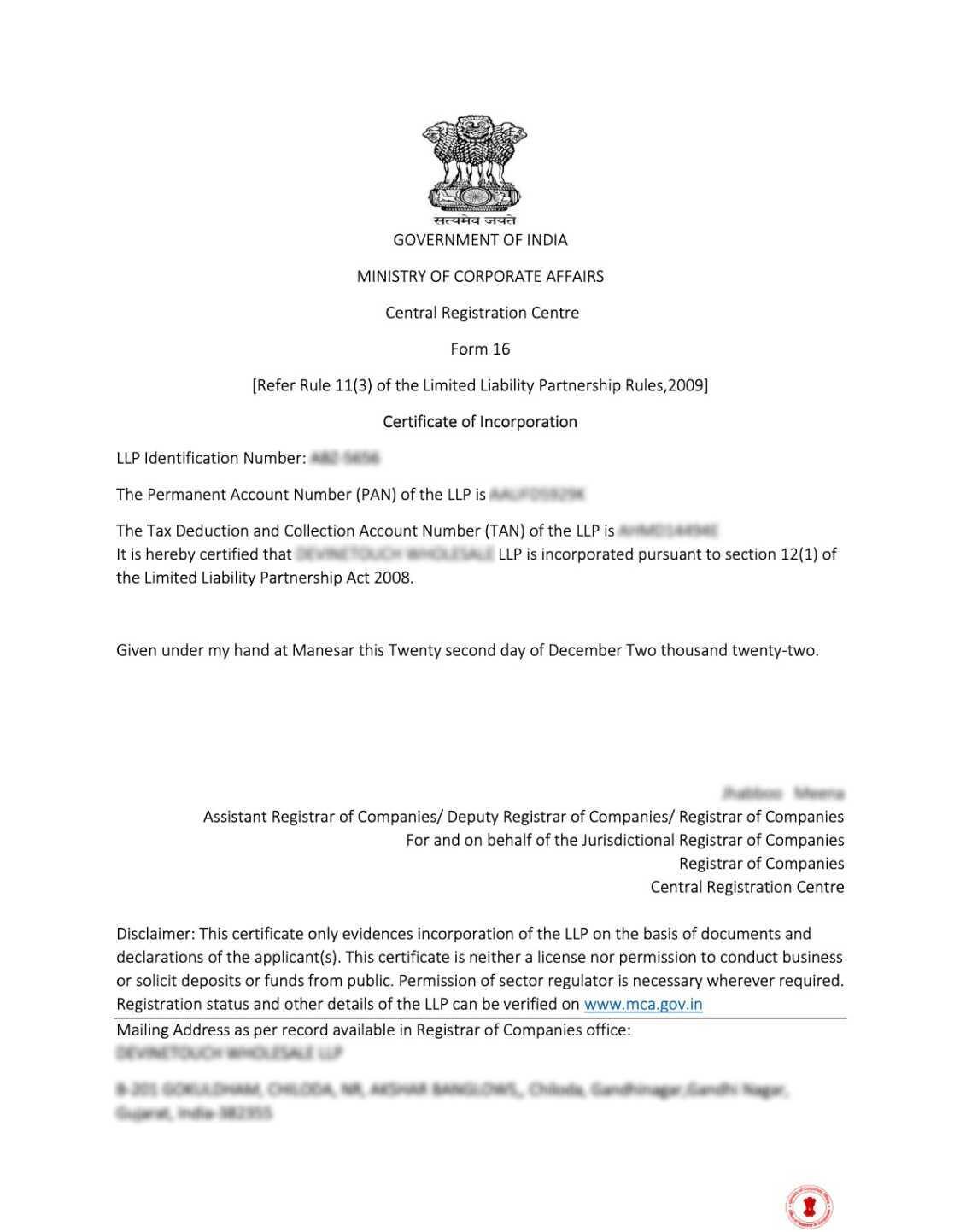
How to Download the LLP Incorporation Certificate Online?
To download your LLP Incorporation Certificate:
- Visit the official Ministry of Corporate Affairs (MCA) portal: mca.gov.in.
- Click on ‘MCA Services’ → ‘LLP Services’.
- Select ‘View/Download LLP Incorporation Document.’
- Enter your LLPIN (LLP Identification Number) and Date of Incorporation.
- Complete the CAPTCHA and submit.
- Your LLP Certificate of Incorporation will be available for download in PDF format.
How to Check LLP Registration Status Online?
To check your LLP registration status:
- Go to the MCA website: mca.gov.in.
- Click on ‘MCA Services’ → ‘LLP Services’ → ‘Check LLP Name/Status’.
- Enter your proposed LLP name or application number.
- The status will display as Approved, Pending, Rejected, or Under Processing.
- For any delays or issues, contact the Registrar of Companies (ROC) or your service provider.
How Much Time Does It Take to Register an LLP?
Registering an LLP usually takes around 10 to 15 working days, depending on how quickly you submit documents, how soon the name is approved, and how efficiently the government processes the application.
With professional assistance, the timeline can often be reduced through error-free and streamlined submission.
Key Timeline Breakdown:
- Day 1–2: Apply for Digital Signature Certificates (DSC)
- Day 3–5: Name reservation via RUN-LLP (Reserve Unique Name)
- Day 6–10: Filing incorporation forms with MCA (FiLLiP form)
- Day 11–15: Certificate of Incorporation issued, LLP is officially registered
Note: Timeline may vary based on case complexity, document verification, and government workload.
Fees & Penalties of LLP Registration in India
Understanding the total cost of LLP registration in India, including government fees, professional charges, and potential penalties, is essential for entrepreneurs.
Registration Costs
Registration costs for LLPs vary based on the capital contribution and professional services required for accurate submission.
- Name Reservation Fee: Rs. 200 for filing the RUN-LLP form.
- Incorporation Fee:
- Rs. 500 for LLPs with capital contribution up to Rs. 1 lakh
- Rs. 2,000 for contributions between Rs. 1 lakh to Rs. 5 lakhs
- Rs. 4,000 for contributions between Rs. 5 lakhs to Rs. 10 lakhs
- Rs. 5,000 for contributions above Rs. 10 lakhs
- Digital Signature Certificate: Rs. 1,000 – Rs. 3,000 per designated partner, depending on validation level and provider.
- DIN/DPIN Application: Rs. 500 per designated partner.
- Professional Services: Rs. 6,000 – Rs. 15,000 for complete LLP registration assistance.
- LLP Agreement Drafting: Rs. 3,000 – Rs. 10,000 depending on complexity and customization requirements.
- Stamp Duty for LLP Registration: Varies by state, typically ranging from 0.1% to 1% of the capital contribution.
Note: The fees mentioned above don’t cover the charges an LLP registration consultant might take for their services.
Penalties and Charges for LLP Registration
Penalties and consequences for incorrect or delayed LLP registrations and compliance can include fines, interest charges, and legal action, depending on the severity of the issue.
- Late Filing of LLP Agreement (Form 3): Rs. 100 per day up to a maximum of Rs. 5,000.
- Delayed Annual Returns (Form 11): Rs 100 per day for the period of delay.
- Late Filing of Statement of Accounts (Form 8): Rs. 100 per day for the period of delay.
- Non-Compliance with Various Provisions: Penalties ranging from Rs. 1,000 to Rs. 5 lakhs, depending on the nature of the violation.
- Operating without Registration: Can result in personal liability for all partners and potential legal actions.
- False Statements in Documents: Penalties up to Rs. 5 lakhs and potential criminal proceedings.
- Non-Disclosure of Interest by Partners: Fine up to Rs. 1 lakh for the LLP and the concerned partner.
- Conducting Prohibited Business: Cancellation of registration and penalties up to Rs. 5 lakhs.
For the complete fee details, read our comprehensive guide on LLP registration fees in India.
Key Characteristics of an LLP Registration
An LLP registration has distinct characteristics that shape how these business entities function:
- Limited Liability Protection
- Partners’ liability is limited to their agreed contribution, protecting personal assets.
- This ensures business liabilities don’t extend to the personal property of the partners.
- Separate Legal Entity
- LLP exists as a distinct legal entity separate from its partners.
- The LLP can own assets, incur liabilities, and enter into contracts in its name.
- Perpetual Succession
- LLP continues to exist regardless of changes in partnership, ensuring business continuity.
- Death, retirement, or insolvency of partners doesn’t affect the existence of the LLP.
- Flexible Capital Contribution
- No minimum capital requirement for LLP formation.
- Partners can contribute as agreed in the LLP Agreement with flexibility in capital structure.
- Internal Autonomy
- LLP structure allows partners to organize internal operations as per mutual agreement.
- The management structure, rights, and responsibilities can be customized in the LLP Agreement.
- Tax Transparency
- Profits are taxed only at the LLP level without dividend distribution tax.
- This provides tax efficiency compared to private limited companies.
- Ease of Compliance
- Simpler regulatory requirements compared to companies.
- Fewer mandatory filings and no requirement for statutory audits for LLPs with turnover below Rs. 40 lakhs.
- Business Scalability
- Allows an unlimited number of partners, facilitating business growth and expansion.
- New partners can be added easily as per the terms in the LLP Agreement.
Why Should You Register an LLP?
Still wondering if registering an LLP is compulsory? Discover the key benefits of LLP registration in India, from legal protection to tax advantages and greater operational flexibility:
- Limited Liability Protection
- Shields partners’ assets from business liabilities.
- Limits financial risk to the extent of the capital contribution made by each partner.
- Tax Benefits
- Avoids double taxation applicable to companies.
- No dividend distribution tax on profit distribution to partners.
- Minimal Compliance Burden
- Requires fewer statutory compliances compared to private limited companies.
- Audit requirements are only applicable when turnover exceeds Rs. 40 lakhs.
- Flexible Capital Structure
- No minimum capital requirement for formation.
- Partners can contribute as per mutual agreement with easy capital restructuring.
- Business Continuity
- Ensures perpetual succession regardless of changes in partnership.
- Business operations continue smoothly despite partners joining or leaving.
- Professional Credibility
- Enhances business reputation in the market and with financial institutions.
- Provides a legitimate business structure for accessing credit facilities.
- Ease of Ownership Transfer
- Facilitates smooth transfer of ownership with partner consent.
- Allows flexible entry and exit mechanisms as per the LLP Agreement.
- Scalability
- Accommodates unlimited partners for business expansion.
- Provides structure suitable for growing businesses across various sectors.
Still exploring your options? You might also want to check out our Company Registration services.
Limited Liability Partnership (LLP)
A Limited Liability Partnership (LLP) is a business structure that combines features of both partnerships and corporations, particularly popular for small to medium-sized businesses and professional firms. An LLP is often chosen by entrepreneurs who want a flexible structure with liability protection without the stringent regulatory requirements of a corporation. Here are the main aspects of an LLP:
- Limited Liability: Partners in an LLP have limited liability, which means they are only responsible for the debts of the business up to their investment in it. Personal assets are generally protected.
- Separate Legal Entity: An LLP is treated as a separate legal entity from its partners, so it can enter into contracts, own assets, and be held accountable independently of the individuals involved.
- Flexibility in Management: LLPs offer flexibility in management and organizational structure, as partners can decide on roles, responsibilities, and profit-sharing arrangements in the LLP agreement without strict corporate formalities.
- No Maximum Limit on Partners: While an LLP requires at least two partners, there’s no upper limit, making it suitable for businesses needing a large team of partners.
- Perpetual Succession: An LLP continues to exist regardless of changes in the partners, similar to a corporation. This provides continuity, as the entity isn’t impacted by the death or departure of any partner.
- Tax Benefits: LLPs are often taxed as partnerships, which means the business itself isn’t taxed on profits. Instead, profits pass through to the partners, who report income on their tax returns, avoiding double taxation.
- Less Compliance: Compared to private limited companies, LLPs generally have fewer compliance requirements, making them easier and cheaper to maintain.
- Suitable for Professionals: LLPs are particularly favored by professional firms like law, accounting, consulting, and other service-based businesses because of the liability protection and partnership flexibility.
Limited Liability Partnership(LLP) Company Registration in Delhi
Choose this plan to get your Limited Liability Partnership Firm registered along with FREE GST Registration.
What is Limited Liability Partnership Firm? or Partnership Firm
- LLP is alternative corporate business form that gives the benefits of limited liability of a company and the flexibility of a partnership.
- The LLP is a separate legal entity, is liable to the full extent of its assets but liability of the partners is limited to their agreed contribution in the LLP.
- Further, no partner is liable on account of the independent or un-authorized actions of other partners, thus individual partners are shielded from joint liability created by another partner’s wrongful business decisions or misconduct.
Taxgoal is one of most trusted CA agent that offers LLP Company Registration in Delhi Gurgaon Noida and over the India with 100% transparency. We also provide Partnership Firm Registration in Delhi India
Services Covered
- FREE GST REGISTRATION
- Filing of E-forms with the Registrar of Companies (ROC)
- Designated Partner Identification Numbers-DPINs (2 nos.)
- Digital Signature Certificates-DSCs (2 nos.)
- Name Approval
- PAN Application
- TAN Registration
- Issue of Certificate of Incorporation
- Includes Government Fees and Stamp Duty upto 1 Lakh Capital Contribution by Designated Partners
For Whom this plan is?
- Companies, body corporates or already existing partnerships
- LLPs registered outside india
- Startups and SMEs looking for carrying business with minimal legal formalities
Documents Required
- ID Proof of Partners such as PAN, AADHAAR
- Address Proof of Partners such as Voter’s ID, Passport, Driver’s license or Aadhar Card.
- Residence Proof of Partners such as Latest bank statement, telephone bill, mobile bill, electricity bill or gas bill.
- Passport size photograph of partners
- Proof of Registered Office Address such as rent agreement/NOC form owner
- Any other document as necessary
What is LLP Registration in Delhi?
LLP is an alternative corporate business form that gives the benefits of the limited liability of a company and the flexibility of a partnership. The LLP can continue its existence irrespective of changes in partners. It is capable of entering into contracts and holding property in its own name. The LLP is a separate legal entity, is liable to the full extent of its assets but liability of the partners is limited to their agreed contribution in the LLP. Further, no partner is liable on account of the independent or unauthorised actions of other partners, thus individual partners are shielded from joint liability created by another partner’s wrongful business decisions or misconduct. Mutual rights and duties of the partners within an LLP are governed by an agreement between the partners or between the partners and the LLP as the case may be. The LLP, however, is not relieved of the liability for its other obligations as a separate entity.
What are the features of LLP Partnership Registration?
LLP is a body of corporate
LLP is a body corporate, formed and incorporated under the Act. It is a legal entity separate from its partners.
Perpetual Succession
A limited liability partnership can continue its existence even after the retirement, insanity, insolvency or even death of one or more partners. Further, it can enter into contracts and hold property in its name.
Separate Legal Entity
A LLP is a separate legal body. Further, it is completely liable for its assets. Also, the liability of the partners has certain limitations in their contribution to the LLP. Hence, the creditors of the LLP are not the creditors of individual partners.
Mutual Agency
Another difference between an LLP and a partnership firm registration is that the independent or unauthorized actions of one partner do not make the other partners liable. All partners are agents of the LLP and the actions of one partner do not bind the others.
LLP Agreement
An agreement between all partners governs the rights and duties of all the partners. Also, the partners can devise the agreement as per their choice. If such an agreement is not made, then the Act governs the mutual rights and duties of all partners.
Artificial Legal Person
For all legal purposes, LLP is an artificial legal person. A legal process creates it and has all the rights of an individual. It is invisible, intangible, and immortal but not fictitious since it exists.
Common Seal
If the partners decide, the LLP can have a common seal [Section 14(c)]. It is not mandatory though. However, if it decides to have a seal, then it is necessary that the seal remains under the custody of a responsible official. Further, the common seal can be affixed only in the presence of at least two designated partners of the LLP.
Limited Liability
According to Section 26 of the Act, every partner is an agent of the LLP for the purpose of the business of the entity. However, he is not an agent of other partners. Further, the liability of each partner has limitations to his agreed contribution to the LLP. It provides personal liability protection to its partners.
Minimum and Maximum Number of Partners in an LLP
Every Limited Liability Partnerships must have at least two partners and at least two individuals as designated partners. At any time, at least one designated partner should be resident in India. There is no maximum limit on the number of maximum partners in the entity.
Business Management and Business Structure
The partners of the LLP can manage their business. However, only the designated partners are responsible for legal compliances.
Business for Profit Only
Limited Liability Partnerships cannot be formed for charitable or non-profit purposes. It is essential that the entity is formed to carry on a lawful business with a view to earning a profit.
Investigation
The power to investigate the affairs of an LLP resides with the Central Government. Further, they can appoint a competent authority for the same.
Conversion into LLP
A private company, firm, or an unlisted public company or a small business can convert into an LLP in accordance with the provisions of the Act.
What documents are required for registering a Limited Liability Partnership in India?
For getting a LLP registered in India following documents are required. Please refer below the documents required for registering a LLP and the list is illustrative and we may require additional documents and information from time to time to complete the registration.
- Passport sized photographs of all the Directors
- Identity Proof – PAN Card/Passport if applicant is foreign national, voter ID.
- Address Proof – Driving license or Aadhar card and bank statement or utility bill not older than two months.
- Place of business – Ownership documents/ lease deed, Electricity Bill, bank statement or telephone bill not older than two months. The No Objection from the owner to use the premises as a registered office.
- Proof of evidence of any utility services like gas, electricity, telephone stating the address of the premises bearing the name of the owner or document not older than two months.
- Any other document or details if required will also be communicated
Taxcellent helps you register a Limited Liability Partnership within 20 days. We promise you to provide the best service for Company registration and compliances activities.
LLP Registration- Documents Required
What is LLP Registration
LLP Registration is a type of partnership firm which is mostly preferred by the entrepreneur. It is the easiest form of business structure with the benefit of limited liability. LLP registration gives freedom to partners to form a partnership structure where the liability of each partner is limited to the amount they contribute to the business. Limited liability partnership firm registration means that if the partnership fails, creditors cannot ask for the partner’s personal property or income.
What is a Limited Liability Partnership Firm?
LLP Registration is a type of business structure that offers extra benefits in comparison to the partnership firm. It provides limited liability to its partners at very nominal compliance costs. Moreover, the Partners of the firm can organize their internal structure like a partnership firm.
In short, LLP is a separate legal entity from its member that has the power to extend all its assets keeping the liabilities of partners limited. Hence, an LLP Registration In Delhi is a hybrid of a company and a partnership firm.
Benefits of LLP Registration

- Enjoys The Status Of Corporate Bodies : As per Section 3 of the Limited Liability Partnership Act, 2008, under LLP registration a firm is a corporate body that has come into force with effect from April 1, 2009. The Indian Partnership Act 1932 does not apply to LLP.
- Perpetual Succession : A Limited Liability Partnership firm has the benefit of perpetual succession and can continue its existence even after the retirement, death, insanity of one or more respective partners in the firm.
- Shares Limited Liability : The most important feature of LLP is limited liability that all its partners should entertain which means their assets are safe and won’t be used to pay the losses or debt of the firm. Apart from it, innocent partners of a Limited Liability Partnership firm are not liable to pay for the wrong deeds done by some other partner.
- Fewer Credentials Are Required : A person can start an LLP firm with just two partners out of which one should be an Indian resident. The designated partners of a limited liability partnership firm can either be an individual or a corporate body. Moreover, there is no specific capital requirement to incorporate a limited liability partnership firm registration.
- Quicker Decision Making Process : An agreement is printed on stamp paper and signed by all the partners that define their roles and duties in the firm. It helps them in the decision-making process.
Easy Online Registration And E-Filling
MCA has simplified LLP registration and made it an easy online procedure. The forms and the documents are filed electronically on the official MCA portal. A designated partner of a limited liability partnership firm has to obtain DSC to sign these documents and forms.
- Easy Conversion : If a public or private company or a partnership firm decides to emerge as a limited liability partnership, they can easily convert as per the provisions of the applicable act.
- Efficient Business Management : The business is managed by the respective partners as per their roles and duties. The designated partners of the firm are responsible for the legal compliances.
- Profit-Sharing Business : Profit is equally shared amongst all the partners of a limited liability partnership firm. An LLP registration cannot be incorporated for a charitable purpose. Its purpose is to carry on business activities to earn profit.
Documents Required for LLP Registration
Here is a list of documents required for registration :
Documents Of Partners :
- ID Proof/PAN Card of the Partners
- Residential Proof of the partners
- Copies of Passport size Photograph
- Passport (in case of Foreign Nationals/ NRIs)
Documents Of LLP :
- Copies of the Proof of Registered Office
- DSC-Digital Signature Certificate
Documents of Partners
- ID Proof/PAN Card/ Of Partners : All the partners of the firm are needed to provide their PAN card at the time of registering Limited Liability Partnership.
- Residential Proof Of Partners : Partner must submit anyone out of Passport, Driver’s license, Voter’s ID, or Aadhar Card. Moreover, the name & other details as per address proof & PAN card must be the same.
- Photograph : Partners should also provide their passport size photograph, preferably on white background.
- Passport (In Case Of NRIs/Foreign Nationals) : Foreign nationals & NRIs have to submit their passport mandatorily for becoming a partner in Indian Limited Liability Partnership. Passport has to be duly notarized by the concerned authorities in the country of such foreign nationals & NRI, in addition, the Indian Embassy placed in that country can also authorize the documents. They have to submit proof of address also which will be a bank statement, driving license, residence card/any government-issued identity proof including the address.
Documents of LLP Registration
- Proof Of Registered Office Address : Proof of registered office must be submitted during the LLP registration within 30 days of its incorporation. If the designated registered office is taken on rent, in that case, the rent agreement and a NOC- no objection certificate from the landlord must be submitted.
No objection certificate will act as the consent of the landlord to give permit the LLP to use the place as a ‘registered office’ and operate its business.
In addition, anyone document out of utility bills like electricity, gas, or telephone bill must be submitted along with the application. Those bills must contain the complete address of the located premise and owner’s name & the document shouldn’t be older than the past 2 months.
- Digital Signature Certificate : One of the designated partners of the LLP needs to opt for a DSC (digital signature certificate) as all documents & applications will be digitally signed by the concerned signatory.